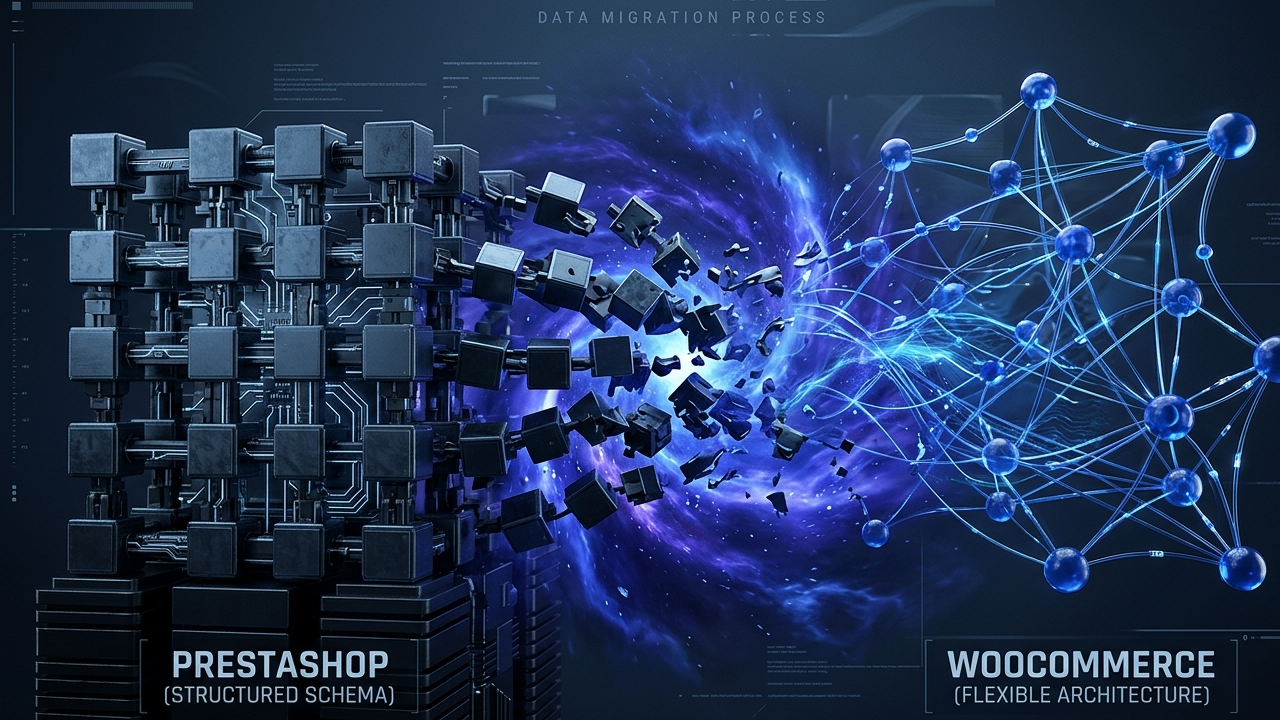
Quantifying the architectural shift from Symfony-based PrestaShop environments to the WordPress/WooCommerce hook-driven ecosystem. This analysis focuses on database re-platforming, infrastructure scaling, and the long-term impact on operational expenditure.
Key Takeaways (TL;DR)
- Infrastructure Efficiency: Moving from PrestaShop to WooCommerce reduces technical debt by leveraging the extensive WordPress ecosystem, though it necessitates specialized object-caching (Redis) to maintain scalability.
- Economic Shift: A prestashop to woocommerce migration typically lowers the TCO related to developer man-hours by 25-30% due to the wider availability of senior engineering talent.
- Data Integrity: The transition from PrestaShop’s highly normalized relational schema to WooCommerce’s EAV-heavy (Entity-Attribute-Value) model requires a robust state synchronization strategy to prevent metadata bloat.
- API Performance: Transitioning to a headless storefront via the WooCommerce REST API or GraphQL (WPGraphQL) eliminates legacy theme bottlenecks but requires strict monitoring of API latency.
Executing a prestashop to woocommerce migration represents more than a platform switch; it is a strategic re-alignment of the enterprise’s digital infrastructure. While PrestaShop offers a structured Symfony-based framework, its rigidity often results in higher maintenance costs for bespoke B2B features. WooCommerce, as a decoupled or coupled commerce engine, offers superior flexibility but demands a rigorous enterprise e-commerce TCO analysis to avoid the “plugin-bloat” trap. The architectural decision must be based on the long-term cost of maintaining custom business logic versus the efficiency of the WordPress core.
Database Architecture and State Synchronization
The primary technical challenge during the migration involves mapping PrestaShop’s highly normalized database tables (e.g., `ps_product`, `ps_product_lang`, `ps_category_product`) to the more fluid WordPress `wp_posts` and `wp_postmeta` structure. While PrestaShop’s architecture is optimized for relational integrity, WooCommerce’s reliance on metadata facilitates rapid attribute extension. However, without implementing High-Performance Order Storage (HPOS), large-scale WooCommerce installations will suffer from query degradation as the `wp_postmeta` table exceeds 10 million rows.
For enterprises managing over 50,000 SKUs, state synchronization between the legacy ERP and the new WooCommerce instance must be handled via a dedicated middleware. This prevents the commerce engine from being overwhelmed during heavy write operations, ensuring that the frontend remains performant and accessible to search bots.
Comparative TCO Analysis: Native vs. Re-platformed
| Cost Variable | PrestaShop (Legacy Stack) | WooCommerce (Optimized Stack) |
|---|---|---|
| Maintenance (Dev-Ops) | High (Specialized Symfony/Smarty) | Moderate (Standard PHP/Hooks) |
| Third-party Licensing | Paid Modules (Fragmented) | Subscription-based (SaaS Plugins) |
| Infrastructure Scaling | Vertical Scaling (Server-heavy) | Horizontal Scaling (Cloud-ready) |
| API Orchestration | Legacy REST (Inconsistent) | Standardized REST / GraphQL |
API Latency and Headless Implementation Patterns
In modern enterprise deployments, a headless storefront is the preferred architectural pattern to isolate the presentation layer from the commerce core. When transitioning from PrestaShop’s native controllers to a WooCommerce-powered headless setup, developers must mitigate API latency. The WordPress REST API can introduce overhead due to the loading of the entire plugin stack on every request. Implementing a custom endpoint or using WPGraphQL is mandatory for achieving sub-200ms response times in a global commerce context.
Adopting MACH architecture implementation patterns allows the enterprise to treat WooCommerce merely as a checkout and inventory manager, while the product discovery is handled by a high-speed search engine like Algolia or Meilisearch. This decoupling is essential for long-term scalability.
Technical Implementation: REST API Ingestion
To ensure a smooth prestashop to woocommerce migration, the ingestion of product data must be performed server-side to bypass PHP timeout limits. The following Node.js snippet illustrates a robust pattern for bulk-importing legacy product data into the WooCommerce REST API with error handling for state synchronization:
const WooCommerceRestApi = require("@woocommerce/woocommerce-rest-api").default;

const api = new WooCommerceRestApi({
  url: "https://enterprise-store.com",
  consumerKey: process.env.WC_KEY,
  consumerSecret: process.env.WC_SECRET,
  version: "wc/v3"
});

// Bulk data ingestion from PrestaShop JSON export
async function migrateProducts(products) {
  const data = { create: products };

  try {
    const response = await api.post("products/batch", data);
    console.log(`Ingested ${response.data.create.length} products.`);
    // Monitor API Latency and handle 429 Too Many Requests
  } catch (error) {
    console.error("Migration Error:", error.response.data);
  }
}
Scalability and Performance Optimization
Long-term TCO is heavily influenced by how the platform handles traffic spikes. Unlike PrestaShop, which requires complex Varnish configurations to cache dynamic content, WooCommerce can leverage WordPress’s robust object-caching layers. For enterprises, headless commerce performance optimization involves moving the logic for tax calculation and shipping rates to serverless functions, thereby reducing the load on the WooCommerce database and decreasing the overall server-side execution time.
Architectural Outlook
In the next 18-24 months, we expect WooCommerce to further solidify its enterprise standing with the full maturation of HPOS and the integration of more native multi-site capabilities. The prestashop to woocommerce migration trend will accelerate as companies seek to reduce the “developer tax” associated with legacy Symfony frameworks. We anticipate a shift toward “Commerce Orchestration” where WooCommerce acts as a modular service within a larger MACH architecture, rather than a monolithic all-in-one solution. Enterprises will increasingly prioritize API throughput and data portablity as they move toward multi-platform hybrid strategies.