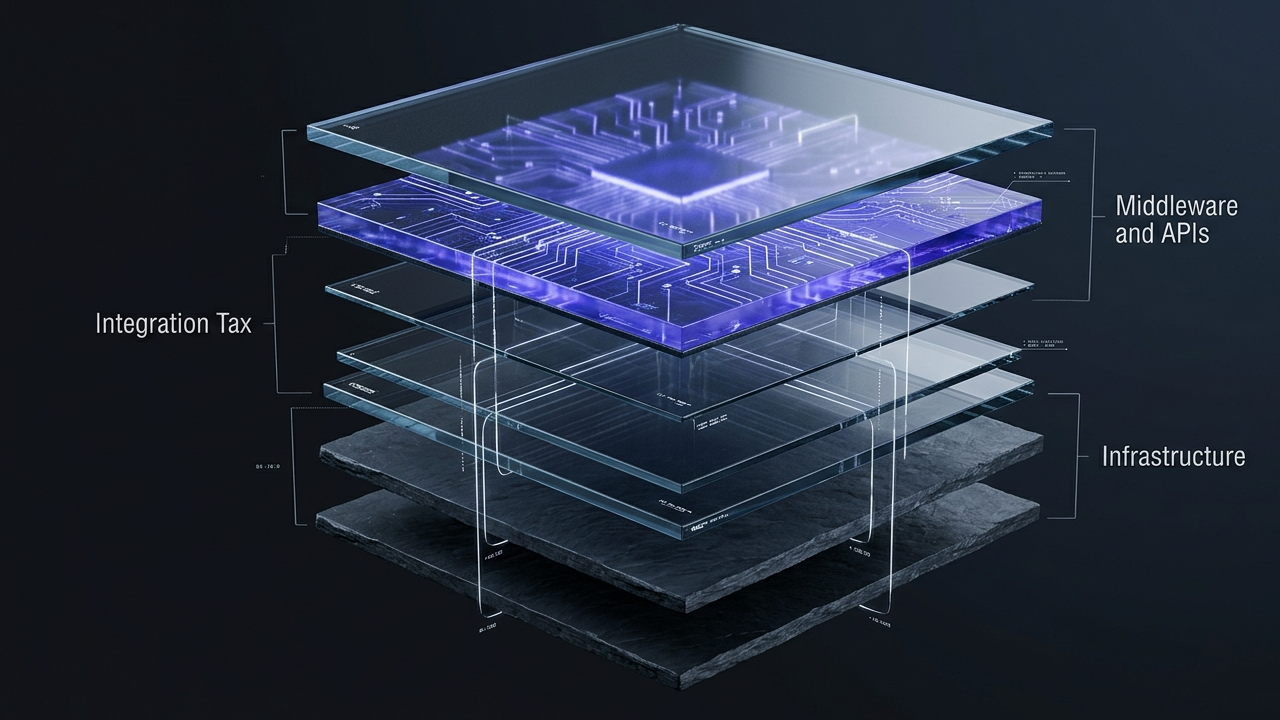
Quantifying the hidden cost drivers of decoupled architectures: from middleware orchestration to the dev-ops tax. A senior architect’s guide to the economic reality of the MACH ecosystem.
Key Takeaways (TL;DR)
- Orchestration Overhead: Headless architectures shift costs from “platform licenses” to “system integration,” increasing the initial implementation budget by 120% to 200%.
- Dev-Ops Tax: Managing a multi-vendor service mesh requires dedicated CI/CD pipelines and monitoring tools (Datadog, New Relic), adding a permanent 15-20% Opex increase.
- Middleware Requirement: Sub-second performance necessitates a Backend-for-Frontend (BFF) layer to mitigate API latency, introducing a new tier of technical maintenance.
- Economic Inversion: While Capex is significantly higher, the long-term scalability reduces the cost per transaction at high GMV volumes (>$100M).
The primary reason **why is headless so expensive** lies in the transition from managing a single application to orchestrating a distributed system. In a monolithic environment, the persistence layer, business logic, and presentation layer reside in a shared kernel. Decoupling these components via **MACH architecture** requires the introduction of a robust integration mesh. Engineering teams no longer simply “theme” a storefront; they must build and maintain a custom **headless storefront** that consumes data from a fragmented ecosystem of PIMs, CMSs, and ERPs, necessitating a rigorous enterprise e-commerce TCO analysis before the first line of code is written.
Infrastructure and Orchestration: The Cost of Decoupling
In a headless paradigm, the complexity of **state synchronization** across various microservices is the main driver of technical debt and expenditure. Unlike a monolith where the database transaction is atomic, a headless setup requires distributed transactional logic. Ensuring that the inventory level in the ERP matches the stock status in the commerce engine and the display on the frontend requires event-driven architectures (Kafka, RabbitMQ), which demand specialized engineering talent.
| Cost Center | Monolithic Architecture | Headless (MACH) Architecture |
|---|---|---|
| Hosting & CDN | Single Server/PaaS Cluster | Multi-cloud / Edge Functions |
| Development Hours | Native Templating (Liquid/PHP) | Modern JS (React/Next.js) + API Dev |
| Monitoring/Observability | Standard APM | Distributed Tracing (Tracing across nodes) |
| Security (PCI) | Native/Managed | Shared Responsibility (Higher Scope) |
Why is headless so expensive? The Middleware Factor
The performance of a decoupled system is only as fast as its slowest API. Without a middleware layer, a browser must make 10-15 asynchronous calls to populate a single Product Detail Page (PDP). This introduces catastrophic **API latency** and degrades Core Web Vitals. To solve this, enterprises must build a Backend-for-Frontend (BFF). This middleware acts as a GraphQL aggregator, but its development and maintenance constitute a permanent cost center that does not exist in monolithic suites.
Furthermore, applying MACH architecture implementation patterns means the business is now responsible for the uptime of the “glue code” between vendors. If the connection between the CMS and the storefront fails, the site goes down, regardless of the core commerce engine’s status. This necessitates an “Industrial Grade” Dev-Ops approach, further inflating the operational budget.
Technical Implementation: The Cost of API Aggregation
The following Node.js snippet illustrates the complexity of a BFF resolver designed to reduce latency. Maintaining this orchestration logic across hundreds of endpoints is why the engineering payroll for headless teams is typically 2x that of monolithic teams:
// BFF Aggregator: Consolidating multiple microservices
// Every millisecond saved here costs thousands in dev-ops salary
const resolveUnifiedProduct = async (sku) => {
    try {
        // Parallel fetching to mitigate API latency
        const [commerceData, cmsContent, inventoryLive] = await Promise.all([
            fetchCommerce(sku), // Price/Basic Meta
            fetchCMS(sku),      // Rich Content/Media
            fetchERP(sku)       // Real-time Stock
        ]);

        return {
            ...commerceData,
            content: cmsContent.body,
            stock: inventoryLive.quantity,
            isBackorder: inventoryLive.eta > 0
        };
    } catch (e) {
        // Distributed systems require complex fallback logic
        logError('AggregationFailure', { sku, error: e.message });
        return getCachedFallback(sku);
    }
};
Scalability vs. Capex: The Strategic Trade-off
Despite the high entry price, headless commerce offers superior **scalability**. In a monolith, scaling during a 50x traffic spike requires scaling the entire application, which is inefficient. In a headless environment, you can scale only the frontend nodes on Vercel or Netlify while keeping the backend stable. This leads to headless commerce performance optimization that eventually pays dividends in conversion rates and server costs, but only after the initial “Architectural Tax” has been paid.
Architectural Outlook
Over the next 18-24 months, the cost of headless will decrease through “Composable Frontends-as-a-Service” (FEaaS). These platforms provide the pre-built orchestration layers that currently consume most of the implementation budget. However, as AI-driven agents begin to autonomously navigate APIs, the new cost frontier will move toward “Data Intelligence Orchestration”—the ability to process real-time customer state across the service mesh. The question for CTOs will move from **why is headless so expensive** to how much they are willing to pay for the ultimate flexibility of a zero-lock-in stack.