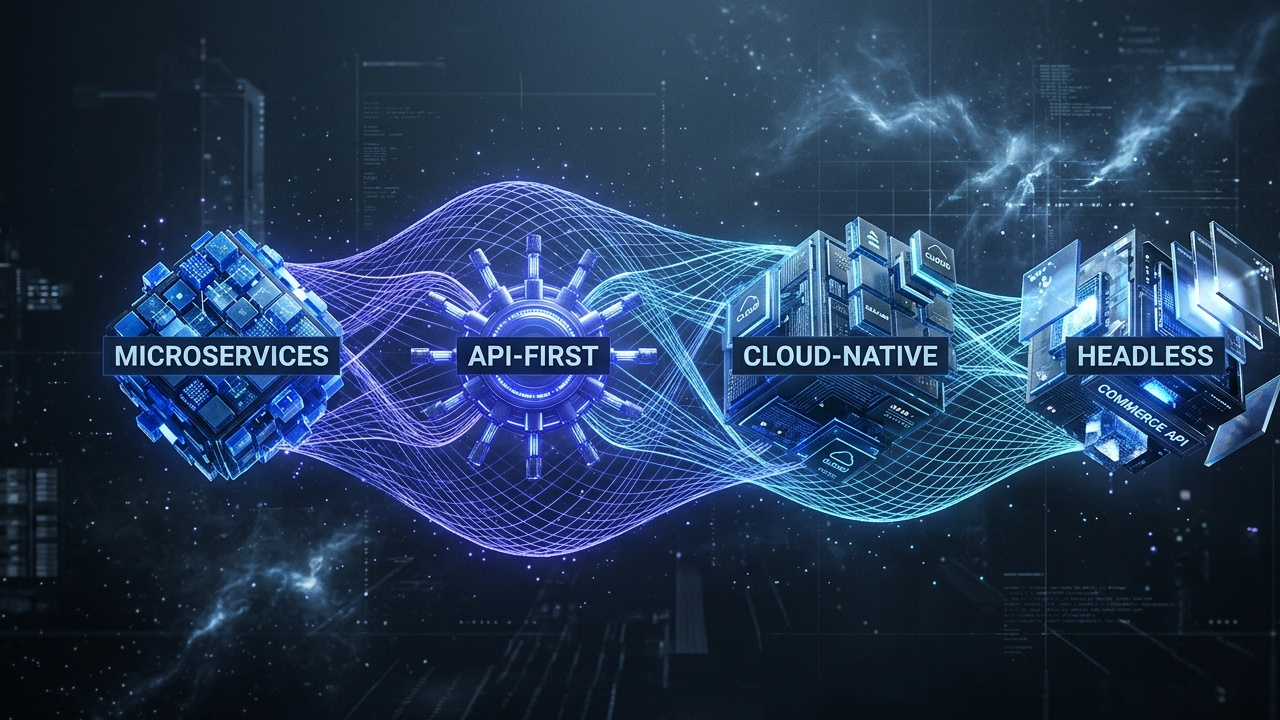
Transitioning to MACH architecture eliminates monolithic interdependency, enabling independent scaling of commerce services and significantly reducing long-term technical debt in enterprise ecosystems.
Key Takeaways (TL;DR)
- Independent Scalability: MACH allows for horizontal scaling of specific microservices (e.g., checkout or search) without the overhead of scaling the entire monolithic kernel.
- Vendor Agnosticism: The API-first approach mitigates “vendor lock-in,” enabling a best-of-breed selection of PBCs (Packaged Business Capabilities) that align with specific business logic.
- Deployment Velocity: Decoupling the frontend from the backend increases release frequency by 5x to 10x, as presentation changes no longer require full-stack regression testing.
- TCO Redistribution: While initial implementation costs are 30% higher, the long-term TCO is reduced by eliminating the cycle of major version re-platforming every 3-5 years.
For the modern CTO, mach commerce represents the final transition from proprietary suites to an open, distributed ecosystem. The acronym—standing for Microservices, API-first, Cloud-native, and Headless—is not merely a marketing buzzword but a set of architectural constraints designed to solve the rigidity of legacy platforms. By moving toward MACH architecture, enterprises can treat commerce capabilities as independent commodities, orchestrated through a central service mesh. This shift requires a rigorous enterprise e-commerce TCO analysis to move budget from “maintenance of the status quo” to “innovation at the edge.”
The Four Pillars of MACH Architecture
Microservices: Decoupling the Business Logic
In a MACH ecosystem, business functionality is broken down into independent microservices. Each service is developed, deployed, and managed autonomously. This granularity ensures that a failure in the loyalty service does not impact the transactional integrity of the checkout process. From an engineering perspective, this increases scalability, as resources can be allocated specifically to high-load services during peak traffic periods.
API-First: The Orchestration Layer
Under mach commerce, all functionality is exposed through APIs. This ensures that the commerce engine is agnostic to the consuming client, whether it is a headless storefront, a mobile app, or an IoT device. The primary challenge here is managing API latency. Architects must implement a robust orchestration layer—often a Backend-for-Frontend (BFF)—to aggregate disparate microservice responses into a single, optimized payload.
| Feature | Legacy Monolith | MACH Architecture |
|---|---|---|
| Upgrades | Manual, disruptive, high-risk | Automatic, continuous, zero-downtime |
| Customization | Core modification (Dirty) | Sidecar / Extension (Clean) |
| Data Flow | Direct DB Access (Synchronous) | API / Event-driven (Asynchronous) |
| Scaling | Vertical (Entire Stack) | Horizontal (Per Microservice) |
Cloud-Native SaaS and State Synchronization
True mach commerce is Cloud-native and multi-tenant SaaS. This means the enterprise no longer manages servers, patches, or database clusters. However, this abstraction introduces the complexity of state synchronization. When using best-of-breed vendors for PIM, CMS, and Commerce, the system must maintain a unified state across the distributed mesh. Without an event-driven architecture (using Kafka or RabbitMQ), data drift between the product catalog and the availability engine is inevitable.
Implementing headless commerce performance optimization is mandatory to counteract the latency inherent in making multiple network round-trips to different SaaS vendors. This involves utilizing Incremental Static Regeneration (ISR) and edge-side caching to ensure the user perceives a monolithic-like speed despite the underlying distributed complexity.
Technical Implementation: GraphQL Orchestration
The following GraphQL snippet illustrates how a MACH-compliant orchestration layer consolidates data from a specialized CMS and a Commerce Engine. This pattern is essential for minimizing API latency at the storefront level:
// Consolidating PBCs (Packaged Business Capabilities)
// Fetching Product Specs (from PIM) and Live Price (from Commerce Engine)
query GetUnifiedProduct($sku: String!) {
  product(sku: $sku) {
    id
    title
    # Data from specialized PIM microservice
    specifications {
      material
      dimensions
      weight
    }
    # Data from real-time Transactional Engine
    price {
      amount
      currency
      discountedPrice
    }
    # Real-time State Synchronization check
    inventoryStatus {
      isAvailable
      leadTime
    }
  }
}
Navigating the Transition: TCO and Implementation Risks
The move to mach commerce is not without risk. The “Integration Tax”—the effort required to make disparate systems communicate—is the largest hidden cost. CTOs must shift their hiring strategy toward senior developers who understand distributed systems and API contract management. Following established MACH architecture implementation patterns is critical to avoid the “Franken-stack” where poorly integrated services create more technical debt than the monolith they replaced.
Architectural Outlook
Over the next 18-24 months, we expect MACH architecture to evolve toward “Autonomous Orchestration.” As AI agents begin to handle the state synchronization and performance tuning between microservices, the complexity of managing a multi-vendor stack will decrease. The industry will move away from manual “wiring” of APIs toward semantic discovery, where the headless storefront can automatically adapt to changes in the underlying microservices schema without manual code updates. Enterprises that have already established a MACH foundation will be the only ones capable of leveraging these AI-driven efficiencies in real-time.