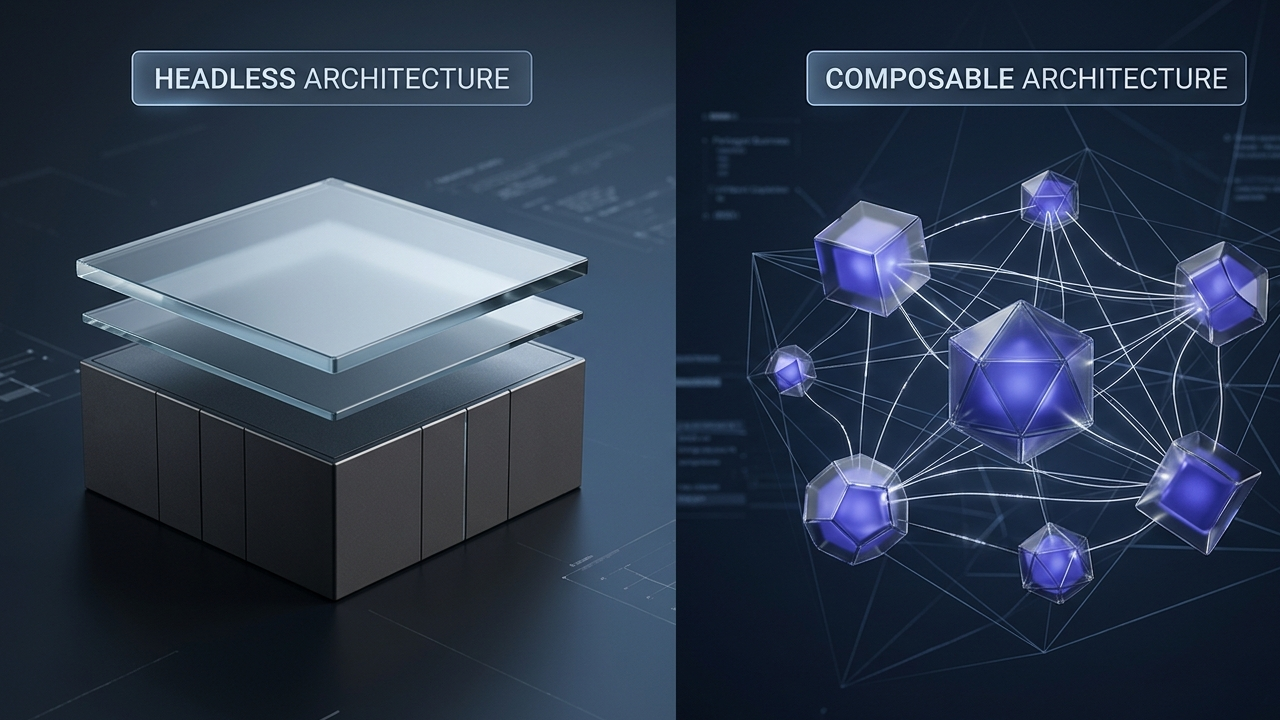
Evaluating the architectural transition from a decoupled frontend-backend relationship to a modular ecosystem of Packaged Business Capabilities (PBCs). Understanding the engineering requirements for multi-vendor API orchestration.
Key Takeaways (TL;DR)
- Granularity of Logic: Headless traditionally decouples the headless storefront from a single commerce core; Composable replaces that core with multiple specialized services (PBCs).
- Operational Risk: Composable commerce eliminates “platform-wide” failures by isolating business logic into independent modules, but increases the “integration tax.”
- Performance Engineering: Composable setups demand a sophisticated middleware layer to prevent API latency spikes caused by orchestrating multiple third-party endpoints.
- Vendor Strategy: Headless remains a “one-to-one” relationship (Front-to-Back); Composable is a “many-to-one” ecosystem requiring a mature DevOps approach.
In the current enterprise landscape, the distinction between commerce composable vs sans tête (headless) is often blurred by marketing terminology, yet the architectural implications are vastly different. Headless commerce is a prerequisite for Composable, but they are not synonymous. While a headless approach focuses on the separation of the presentation layer from the transactional backend, Composable Commerce utilizes the principles of MACH architecture to build an ecosystem where every component—from search to checkout—is a best-of-breed service from a different provider.
Defining the Decoupled Paradigm
The core of a headless strategy is the removal of the “head” (the frontend) from a monolithic or SaaS backend. This allows for superior headless commerce performance optimization by using modern frameworks like Next.js or Remix. However, the backend logic typically remains within a single platform (e.g., Shopify Plus or BigCommerce). Composable Commerce takes this a step further by breaking the backend itself into “Packaged Business Capabilities” (PBCs). Each PBC is an independent service that addresses a specific business function, such as a PIM for data management or a specialized tax engine like Avalara.
This structural evolution requires a rigorous enterprise e-commerce TCO analysis. While headless reduces frontend limitations, Composable increases the engineering overhead because the team must now manage state synchronization between five or more disparate systems instead of one.
Structural Comparison: Architectural Patterns
To understand the technical trade-offs, we must analyze how data flows through the system. In a headless setup, the API layer is usually provided by the primary commerce engine. In a Composable environment, the API layer is often a custom-built or third-party “Orchestration Layer” (BFF – Backend for Frontend) that aggregates data from multiple sources.
| Feature | Headless Commerce | Composable Commerce |
|---|---|---|
| Backend Authority | Single Platform (SaaS or Monolith) | Multiple Specialized Vendors (PBCs) |
| Integration Pattern | Point-to-Point (Front to Back) | Service Mesh / API Orchestrator |
| Data Sovereignty | Centralized in the commerce core | Distributed across PBCs |
| Complexity | Moderate (Frontend-focused) | High (Distributed Systems management) |
State Synchronization in Multi-vendor Environments
When discussing commerce composable vs sans tête, architects must prioritize how the system maintains a “single source of truth.” In a Composable stack, an order created in the “Checkout PBC” must instantly trigger updates in the “Inventory PBC,” the “CRM PBC,” and the “ERP.” Without a robust event-driven architecture (using tools like Kafka or RabbitMQ), the system will inevitably suffer from data drift. Scalability in this context is not just about handling traffic; it is about the system’s ability to maintain data integrity across asynchronous processes.
Furthermore, API latency becomes a cumulative threat. If the frontend must wait for responses from three different vendors to render a Product Detail Page (PDP), the user experience will degrade. Implementation of MACH architecture implementation patterns involves using GraphQL aggregators to fetch data in parallel and cache responses at the edge, ensuring that the modularity of the backend does not compromise the speed of the frontend.
Implementation: Orchestrating PBCs via GraphQL
The following Node.js snippet illustrates how an orchestration layer (BFF) consolidates data from a CMS (Content) and a Commerce Engine (Price/Stock) into a single response, mitigating the latency risks inherent in a Composable setup:
// BFF Aggregator for Composable Commerce
// Reducing API Latency by consolidating PBC responses
const fetchProductPageData = async (sku) => {
    try {
        const [productContent, commerceData] = await Promise.all([
            contentfulClient.getEntry({ content_type: 'product', 'fields.sku': sku }),
            commercetoolsApi.getProductPriceAndStock(sku)
        ]);

        return {
            title: productContent.fields.productName,
            description: productContent.fields.description,
            price: commerceData.amount,
            currency: commerceData.currencyCode,
            available: commerceData.inventoryCount > 0,
            lastSync: new Date().toISOString()
        };
    } catch (error) {
        // Implement fallback strategy for state synchronization failure
        return handleOrchestrationError(sku, error);
    }
};
Headless vs Composable: The Role of Performance Optimization
Performance in commerce composable vs sans tête is managed differently. In headless, optimization is focused on the headless storefront (caching, image optimization, hydration). In Composable, the focus shifts to “Service Mesh” optimization. Every PBC added to the stack increases the potential attack surface and the complexity of the deployment pipeline. Success requires a headless commerce performance optimization strategy that accounts for the “Integration Tax”—the 15-20% overhead required to maintain the glue code between services.
Architectural Outlook
In the next 18-24 months, we expect the emergence of “Pre-composed Stacks” (solutions like Alokai or Front-Commerce) that provide the orchestration layer out of the box, reducing the entry barrier for Composable Commerce. The industry will move away from manual “wiring” of APIs toward “Auto-Orchestration,” where AI-driven middleware layers will manage state synchronization and performance tuning between PBCs automatically. The ultimate goal is a “Zero-Gravity” architecture where vendors can be swapped in real-time with no impact on the overall system uptime.