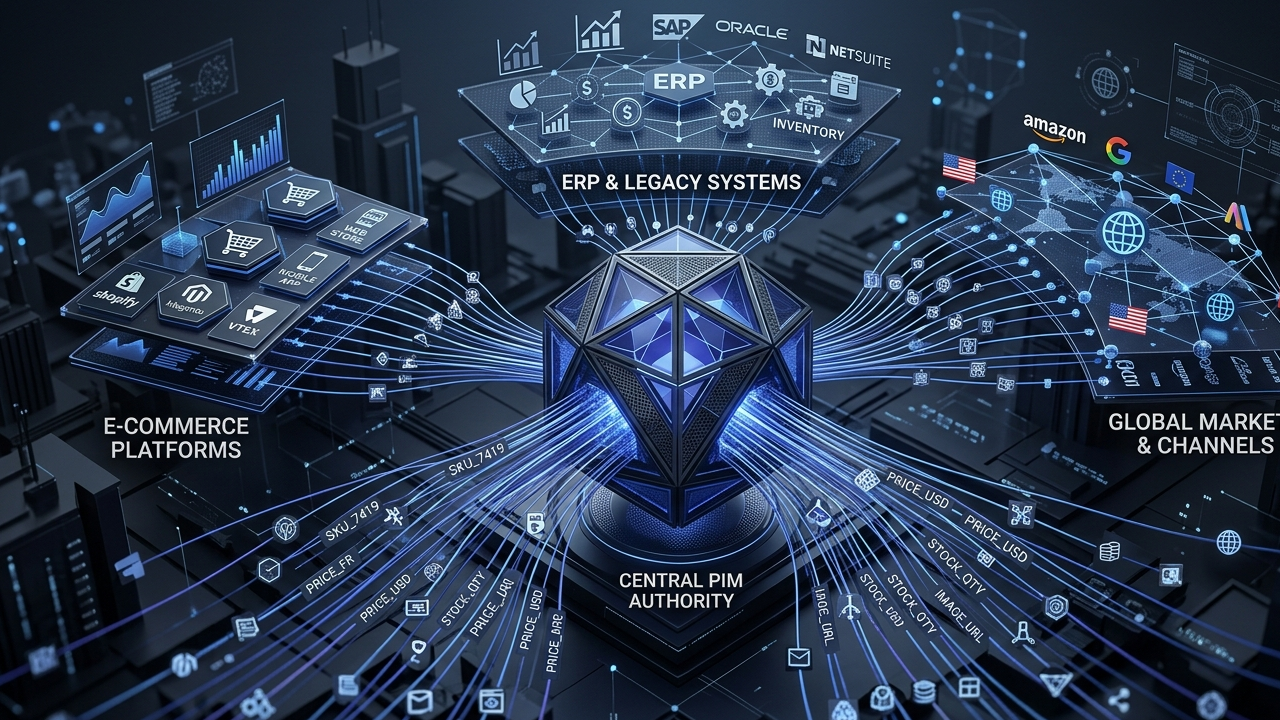
Technical strategies for synchronizing multi-dimensional product data across enterprise e-commerce ecosystems to minimize manual entry and eliminate data silos.
Key Takeaways (TL;DR)
- Operational Efficiency: Automated pim ecommerce integration reduces the SKU-to-Market timeline by up to 70% compared to manual ERP-to-Storefront mapping.
- Data Governance: Offloading attribute management from the commerce engine to a PIM improves core database scalability and reduces platform bloating.
- Conversion Impact: Technical specification accuracy, managed via PIM, directly correlates with a 15-20% reduction in B2B return rates caused by data discrepancies.
- Architectural Decoupling: API-first PIM synchronization is a prerequisite for successful MACH architecture implementation patterns in global multi-storefront setups.
For enterprise B2B organizations, pim ecommerce integration is no longer an optional luxury but a structural necessity. Unlike B2C, where product data is often relatively flat, B2B commerce requires the management of complex hierarchies, multi-level digital assets, and high-granularity technical specifications that vary by region or customer contract. Relying on an ERP or the native commerce platform to store this data leads to performance degradation and increased enterprise e-commerce TCO analysis due to the excessive customization required to handle non-standard attributes.
Data Modeling: Separation of Concerns
The first best practice in B2B data architecture is the strict separation of “Transactional Data” (ERP) from “Marketing/Technical Data” (PIM). The ERP should remain the authority for inventory levels and base pricing, while the PIM acts as the single source of truth for everything the customer sees on the headless storefront. In an integrated environment, the commerce engine should merely be a downstream consumer of these two pipelines, performing state synchronization only at the point of display or checkout.
Integration Patterns: Batch vs. Real-time
Choosing the correct synchronization cadence is critical to managing API latency. While inventory must be near real-time, product descriptions and technical specs are better suited for scheduled delta-syncs or webhook-triggered updates. High-velocity B2B catalogs (over 100k SKUs) often suffer from “API starvation” if the PIM attempts to push full payloads for every minor attribute change.
| Integration Strategy | Mechanism | B2B Use Case | Performance Impact |
|---|---|---|---|
| Webhook-Driven | Event-based push | New product launches | Low overhead; high relevance |
| Bulk REST/GraphQL | Scheduled delta-sync | Mass attribute updates | Moderate (best for off-peak) |
| Middleware/ETL | Transformation layer | Legacy ERP to Cloud PIM | High (adds orchestration layer) |
Technical Implementation: GraphQL Attribute Sync
Modern pim ecommerce integration relies on GraphQL to minimize payload sizes. By requesting only the specific attributes that have changed (e.g., a specific technical certification or an updated material safety data sheet), architects can ensure that synchronization does not interfere with storefront availability. In configurations with over 500 attributes per SKU, the use of GraphQL fragments is mandatory to prevent timeout errors during the ingestion phase.
// GraphQL Mutation for PIM-to-Storefront Attribute Sync
// Target: Updating B2B technical specs without touching the core product record
mutation updateB2BAttributes($productId: ID!, $attributes: [AttributeInput!]!) {
  productUpdate(input: {
    id: $productId,
    metafields: $attributes
  }) {
    product {
      id
      title
      updatedAt
    }
    userErrors {
      field
      message
    }
  }
}

/*
Example Payload:
{
  "productId": "gid://shopify/Product/123456789",
  "attributes": [
    {
      "namespace": "technical_specs",
      "key": "max_load_capacity",
      "value": "5000kg",
      "type": "single_line_text_field"
    }
  ]
}
*/
Handling Digital Assets and Multi-channel Complexity
In B2B, a single SKU may have dozens of associated files: CAD drawings, ISO certifications, and installation videos. A common failure in pim ecommerce integration is attempting to store these files directly within the e-commerce database. Instead, the PIM should pass CDN-backed URLs to the commerce engine. This ensures that the headless storefront can serve assets directly from the edge, significantly reducing API latency and improving the Core Web Vitals (LCP) of technical product pages.
Furthermore, architects must account for “inheritance logic.” In many B2B scenarios, attributes at the “Product” level must cascade to “Variants” while allowing for specific overrides. A PIM-first strategy handles this complexity upstream, delivering a “flattened” and ready-to-consume JSON object to the commerce engine, thereby reducing the computational load on the storefront API.
Architectural Outlook
In the next 18-24 months, we expect pim ecommerce integration to move toward “Real-time Data Fabric” models. Rather than traditional point-to-point sync, enterprises will adopt Event Streams (Kafka/RabbitMQ) where the PIM publishes data to a centralized hub, allowing multiple consumers (E-commerce, Print, Marketplace, CRM) to subscribe to specific attribute updates. This evolution will eliminate the concept of a “sync window,” enabling global B2B brands to maintain 100% data consistency across fragmented MACH architecture landscapes without the historical performance penalties associated with bulk API operations.