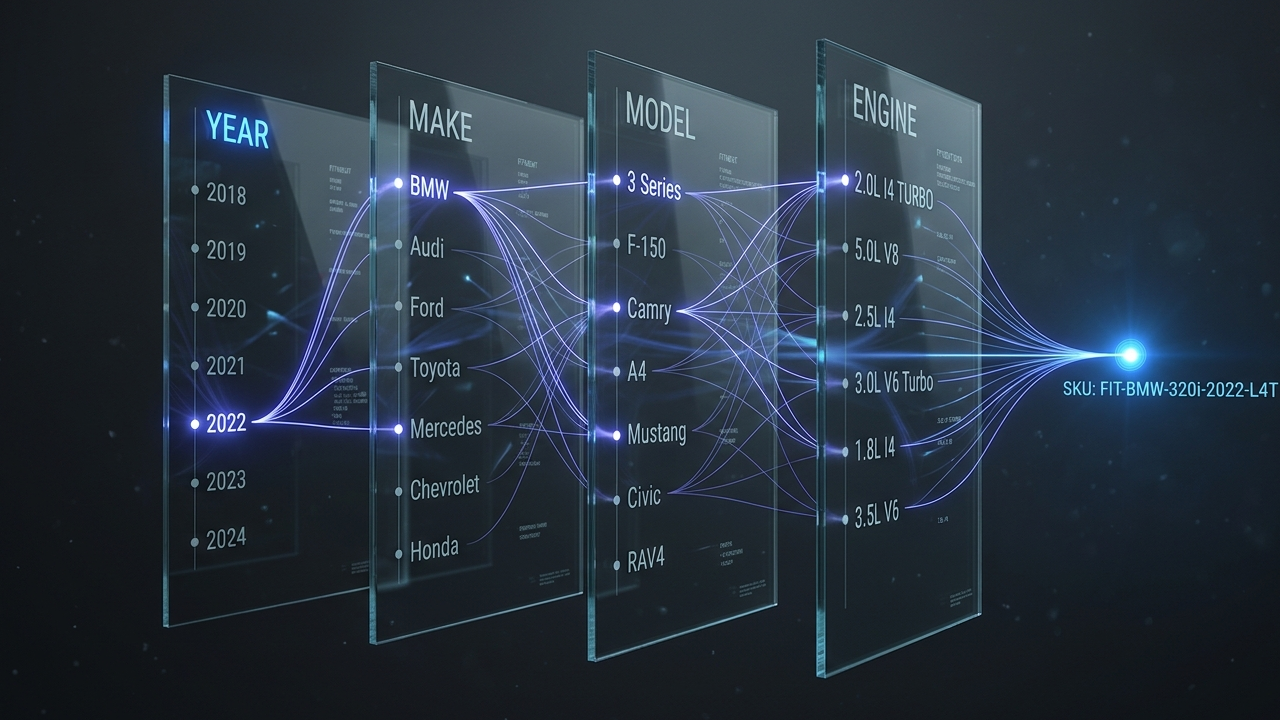
Orchestrating complex Year-Make-Model (YMM) data structures within decoupled enterprise environments is critical for minimizing return rates and maximizing catalog accuracy. This guide analyzes the technical requirements for synchronizing ACES/PIES fitment data between the ERP and a high-performance headless storefront.
Key Takeaways (TL;DR)
- Data Volume Scalability: Managing 10M+ fitment combinations requires a specialized search index (Elasticsearch/Algolia) to bypass the performance bottlenecks of standard relational databases.
- Economic Impact: Automated state synchronization between ACES/PIES records and the storefront reduces manual mapping labor costs by up to 65% in large-scale operations.
- Conversion Engineering: Implementing sub-200ms YMM filtering via edge-side API orchestration results in a 12-18% uplift in technical part lookup completion rates.
- Architecture Strategy: Utilizing MACH architecture implementation patterns isolates fitment complexity from transactional logic, reducing long-term system fragility.
The technical landscape of auto parts ecommerce is unique due to the multi-dimensional nature of the product catalog. Unlike standard retail, a single SKU in the automotive sector can have thousands of “fitment” records, mapping it to specific vehicle configurations based on year, make, model, sub-model, engine, and trim. Achieving scalability while maintaining sub-second search performance necessitates a shift from monolithic data models to a decoupled architecture where fitment data, product technical specifications (PIES), and ERP transactional data are orchestrated via a unified API mesh.
The Fitment Data Challenge: ACES and PIES Orchestration
Engineering for auto parts ecommerce requires strict adherence to industry standards: ACES (Aftermarket Catalog Exchange Standard) for fitment and PIES (Product Information Exchange Standard) for part attributes. In an enterprise environment, the ERP or a specialized PIM (Product Information Management) system acts as the master record. However, pushing these massive relational datasets directly to a headless storefront results in catastrophic API latency. Senior architects must implement a transformation layer that flattens these relationships into a document-based search index, ensuring that Year-Make-Model queries do not lock core database tables during peak traffic.
Architectural Comparison: Relational vs. Document-Oriented Fitment Models
The choice of data modeling directly impacts the enterprise e-commerce TCO analysis. While relational models ensure data integrity at the source, they fail to provide the responsiveness required for modern buyer expectations.
| Architectural Attribute | Relational (SQL-Native) | Document-Based (Search Index) |
|---|---|---|
| Query Performance | Degrades with SKU/Vehicle count | Optimized for high-speed filtering |
| Data Sync Logic | Synchronous / Complex Joins | Asynchronous / Delta updates |
| Fitment Scalability | Limited by IOPS | Horizontally scalable (NoSQL) |
| Maintenance Effort | High (Schema migrations) | Moderate (Index re-hydration) |
ERP Integration and Real-Time State Synchronization
Maintaining state synchronization between the warehouse management system (WMS) and the digital storefront is the primary point of failure in high-volume auto parts ecommerce. Inventory levels must be accurate at the bin level, especially for parts with low turnover or high core deposits. Implementing an event-driven architecture using a message broker ensures that a change in the ERP (e.g., a part being allocated to a physical counter sale) is reflected on the storefront within milliseconds. Failure to do so leads to “split shipments” and high cancellation rates, which erode profit margins.
For headless environments, headless commerce performance optimization is achieved by offloading the “Parts Finder” logic to an edge-side worker. This worker queries a pre-cached version of the fitment index, avoiding the API latency of a round-trip to the heavy ERP database.
Technical Implementation: GraphQL Fitment Query (YMM)
The following GraphQL implementation illustrates a high-performance query designed to fetch parts compatible with a specific vehicle ID while filtering by category and stock availability.
// Headless Auto Parts Finder: Querying by Vehicle ID
query GetCompatibleParts($vehicleId: ID!, $categoryId: ID!) {
  searchParts(
    filter: {
      vehicle_id: $vehicleId,
      category_id: $categoryId,
      in_stock: true
    },
    sort: { relevance: DESC }
  ) {
    total_count
    parts {
      sku
      brand
      price {
        amount
        currency
      }
      # PIES-standard technical attributes
      specifications {
        name
        value
        uom // Unit of Measure
      }
      # Real-time state synchronization status
      inventory_status {
        available_qty
        warehouse_location
      }
    }
  }
}
Managing Returns via Technical Precision
In auto parts ecommerce, return rates can exceed 20% if fitment data is inaccurate. To mitigate this, senior developers must implement a “Fitment Validation” step at the cart level. This microservice performs a final check against the master ACES database before the order is pushed to the ERP for fulfillment. By verifying that the SKU in the cart actually matches the customer’s vehicle profile (saved in the session state), the system prevents the logistical cost of shipping incorrect heavy components.
Architectural Outlook
Over the next 18-24 months, the evolution of auto parts ecommerce will move toward “Predictive Fitment Engines” powered by VIN-decoding APIs and machine learning. We expect a shift from manual YMM selection to autonomous vehicle identification, where the storefront automatically adapts its entire catalog based on the specific telemetry or maintenance history of the user’s fleet. This transition will require even tighter state synchronization between IoT data streams and the core commerce engine, effectively turning the parts catalog into a real-time service utility rather than a static product list. Architects must prioritize 100% MACH compliance today to support these data-heavy agentic buyer flows tomorrow.