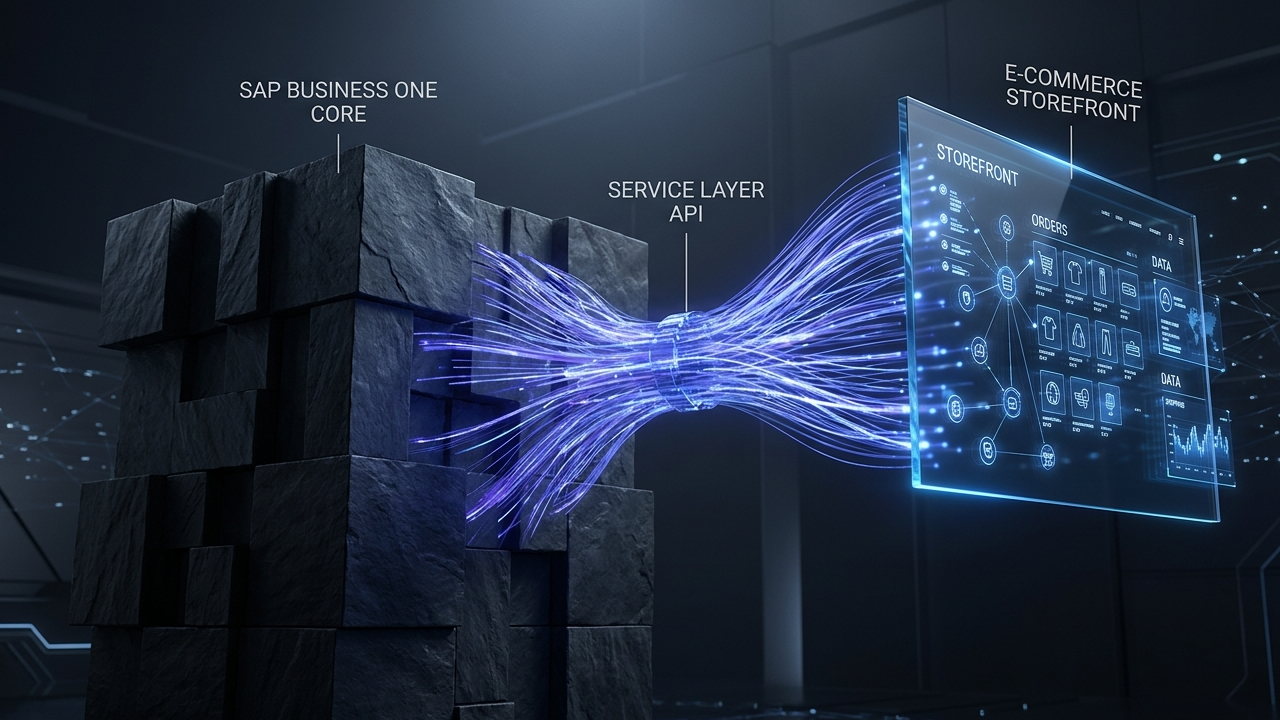
Streamlining the data flow between the SAP Business One Service Layer and enterprise storefronts to ensure high-fidelity transactional integrity. This guide analyzes the architectural patterns required to maintain real-time synchronization across complex B2B landscapes.
Key Takeaways (TL;DR)
- Integration Performance: Utilizing the SAP Service Layer (OData) reduces API latency by up to 60% compared to legacy DI API COM-based integrations.
- Operational Integrity: Real-time state synchronization of inventory and credit limits is mandatory to prevent order rejection in high-velocity B2B environments.
- Infrastructure Strategy: Transitioning to a middleware-based architecture lowers the long-term TCO by isolating ERP logic from frontend volatility.
- Scalability: Decoupling the headless storefront from the SAP backend allows for independent scaling of the presentation layer during peak seasonal loads.
Implementing a robust sap business one e-commerce strategy requires a deep understanding of the SAP Service Layer and its interaction with external digital touchpoints. In enterprise deployments, the ERP acts as the definitive source of truth for pricing, inventory, and customer metadata. However, the architectural challenge lies in exposing this data without introducing significant API latency or compromising the security of the internal network. Successful integrations pivot away from direct database access toward a service-oriented approach, often utilizing MACH architecture implementation patterns to ensure future-proof flexibility.
Architectural Patterns for SAP Business One E-commerce
The choice of integration architecture dictates the performance and maintainability of the entire stack. There are two primary schools of thought: the direct Point-to-Point (P2P) integration and the Middleware-driven approach. While P2P may seem cost-effective initially, it often fails during an enterprise e-commerce TCO analysis due to the high costs of maintaining custom scripts as the business logic evolves.
Comparison: Service Layer (OData) vs. Legacy DI API
| Feature | Service Layer (HANA/SQL) | Legacy DI API |
|---|---|---|
| Protocol | REST / OData (JSON) | COM / SDK (.NET) |
| Performance | High (Multithreaded) | Moderate (Single-threaded) |
| Scalability | Native Load Balancing | Limited (Server-bound) |
| Headless Support | Native | Via Custom Wrapper |
Mitigating API Latency in High-Volume Environments
In a sap business one e-commerce environment, the Service Layer can become a bottleneck if not properly orchestrated. For a headless storefront, every millisecond counts. High-volume B2B portals often trigger complex calculations for contract-specific pricing (Special Prices for Business Partners). To mitigate latency, architects must implement an “Aggregator Middleware” that caches non-volatile data (like product descriptions) while maintaining real-time pipes for volatile data (like stock levels and credit limits).
Technical Implementation: Inventory Synchronization via Service Layer
Ensuring accurate state synchronization requires a robust handling of the OData protocol. Below is an example of a Node.js-based middleware function that updates inventory levels from SAP B1 to a storefront using the Service Layer’s PATCH method:
const axios = require('axios');

async function syncInventoryToStorefront(itemCode, warehouseCode) {
    const sapUrl = `https://sap-server:50000/b1s/v1/Items('${itemCode}')`;

    try {
        // Fetch specific warehouse stock level
        const response = await axios.get(sapUrl, {
            withCredentials: true,
            headers: { 'Cookie': sapSessionCookie }
        });

        const itemData = response.data;
        const warehouseInfo = itemData.ItemWarehouseInfoCollection.find(
            w => w.WarehouseCode === warehouseCode
        );

        // Calculate available stock: InStock - IsCommited
        const availableStock = warehouseInfo.InStock - warehouseInfo.IsCommited;

        // Push to Storefront API (e.g., Shopify, BigCommerce, or Commercetools)
        await storefrontApi.updateStock(itemCode, availableStock);

    } catch (error) {
        console.error('State Synchronization Failed:', error.response.data);
    }
}
Data Mapping and Complex B2B Objects
B2B e-commerce on SAP Business One frequently involves User Defined Fields (UDFs) and complex Business Partner hierarchies. Standard e-commerce platforms do not natively understand SAP’s “Cost Center” or “Project” assignments at the row level. Therefore, the integration layer must perform a “Transformation Logic” to map these SAP-specific objects into the metadata or line-item attributes of the e-commerce order object. Without this mapping, the financial reconciliation in SAP will require manual intervention, negating the efficiency gains of the digital transformation.
Architectural Outlook
Over the next 18-24 months, the evolution of sap business one e-commerce will be driven by the adoption of Event-Driven Architectures (EDA). We will see a shift away from traditional polling-based synchronization toward the SAP Event Broker and Webhook-based triggers. This will virtually eliminate the sync-delay between the ERP and the storefront. Furthermore, as AI-driven procurement grows, the integration layer will need to support “Predictive Reordering” by analyzing historical SAP transactional data to suggest cart additions directly via the storefront API, further reducing the friction in the B2B buyer’s journey.