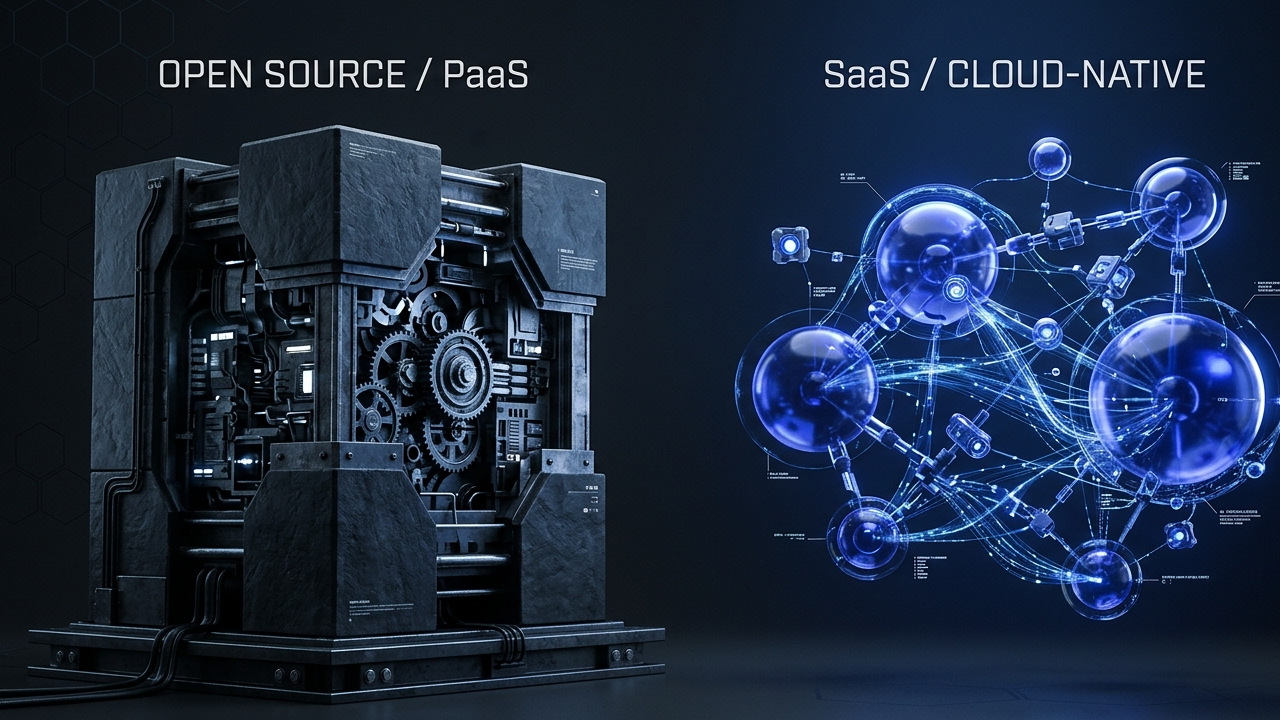
Evaluating the trade-off between kernel-level extensibility and managed infrastructure stability. An analysis of the architectural shifts required to maintain high-availability in complex e-commerce ecosystems.
Key Takeaways (TL;DR)
- Infrastructure Abstraction: Selecting saas vs open source ecommerce dictates the engineering focus; SaaS shifts resources to API orchestration, while Open Source requires full-stack Dev-Ops management.
- Technical Extensibility: Open Source allows for direct persistence layer modification; SaaS confines logic to “out-of-process” extensions and middleware.
- Scalability Economics: SaaS provides native horizontal elasticity; Open Source necessitates manual orchestration of database clusters and load balancers, impacting long-term TCO.
- Deployment Velocity: API-first SaaS environments support higher deployment frequencies by decoupling the core commerce engine from the headless storefront.
The strategic debate between saas vs open source ecommerce has evolved from a simple feature comparison to a fundamental architectural decision. For enterprise organizations, the choice represents the balance between total control over the kernel and the operational efficiency of a managed platform. While Open Source platforms (e.g., Magento/Adobe Commerce) offer unparalleled flexibility for bespoke business logic, they introduce significant technical debt and security overhead. Conversely, SaaS solutions (e.g., Shopify Plus, BigCommerce) provide a stable, PCI-compliant foundation but limit direct database access, forcing a move toward MACH architecture implementation patterns.
Infrastructure Layer: Maintenance vs. Abstraction
The primary technical differentiator in the saas vs open source ecommerce paradigm is the ownership of the infrastructure stack. An Open Source deployment requires a senior Dev-Ops team to manage the operating system, PHP/Java runtimes, and the database (MySQL/PostgreSQL). This complexity directly affects API latency, as the responsibility for optimizing server-side execution and query performance rests entirely on the internal engineering team. In a SaaS model, these layers are abstracted, allowing the enterprise to consume commerce capabilities via high-performance APIs with guaranteed SLAs.
However, architects must recognize that SaaS “black-box” infrastructures can introduce limitations during high-velocity events. If a business requires non-standard database indexing for complex B2B attribute filtering, a SaaS provider’s “governor limits” may become a bottleneck, necessitating an enterprise e-commerce TCO analysis to evaluate the cost of building an external search microservice to handle the load.
Technical Comparison: Architecture and Resource Allocation
| Feature | Open Source (Self-Hosted/PaaS) | SaaS (Multi-tenant) |
|---|---|---|
| Kernel Access | Full access to source code and database | Restricted; API and Hooks only |
| Scaling Pattern | Vertical/Horizontal (Manual/Scripted) | Elastic (Automated by Vendor) |
| Security | Internal Responsibility (Patching/PCI) | Managed by Vendor (PCI-DSS Level 1) |
| Extensibility | In-process (Core Overrides/Plugins) | Out-of-process (Apps/Microservices) |
Scalability and State Synchronization
In high-concurrency enterprise environments, scalability is often limited by the database’s ability to handle write operations. Open Source platforms allow for read/write splitting and advanced sharding, which is essential for massive B2B catalogs with complex pricing rules. However, maintaining state synchronization between a headless frontend and an Open Source backend requires rigorous caching strategies (Redis/Varnish) to prevent database locking during peak loads.
SaaS platforms mitigate this through distributed architectures. For instance, a headless storefront built on a SaaS backbone leverages the vendor’s global CDN. The engineering challenge shifts from server tuning to headless commerce performance optimization, focusing on minimizing the payload of the GraphQL fragments and ensuring that third-party integrations (PIM, ERP, CRM) do not introduce synchronous blockers into the checkout flow.
Technical Implementation: API Orchestration in SaaS
Modern enterprise SaaS environments rely on WebAssembly (Wasm) or serverless functions to inject custom logic into the commerce core without compromising stability. The following example illustrates how a SaaS platform (e.g., via Shopify Functions) might handle a custom B2B discount logic, keeping the execution out-of-process to maintain low API latency:
// Example: B2B Discount Logic in a Decoupled SaaS Environment
// Target: Calculating volume-based discounts for a Company entity

const calculateB2BDiscount = (cartLines, companyMeta) => {
  return cartLines.map(line => {
    const volumeThreshold = 50;
    const discountRate = companyMeta.isPlatinum ? 0.20 : 0.10;

    if (line.quantity >= volumeThreshold) {
      return {
        ...line,
        appliedDiscount: line.price * discountRate,
        strategy: "VOLUME_BASED_B2B"
      };
    }
    return line;
  });
};
Extensibility Paradigms
The saas vs open source ecommerce debate is ultimately a question of where your custom code resides. In Open Source, the code lives *inside* the platform, which simplifies state synchronization but makes upgrades difficult. In SaaS, the code lives *outside* the platform, connected via webhooks and APIs. This necessitates a MACH architecture implementation patterns approach, where the “intelligence” of the commerce operation is distributed across a best-of-breed stack. This modularity reduces the risk of a single point of failure but increases the complexity of the integration mesh.
Architectural Outlook
Over the next 18-24 months, the distinction between saas vs open source ecommerce will blur through the rise of “Out-of-Process” extensibility in Open Source platforms and “Commerce Components” in SaaS. We expect enterprise architects to favor “Hybrid SaaS” models where the core transactional engine is managed SaaS, but the complex business logic is handled in proprietary microservices. The focus will shift from platform features to “Data Liquidity”—the ability to move product and customer state across services with zero latency, effectively turning the commerce engine into a utility rather than a destination.