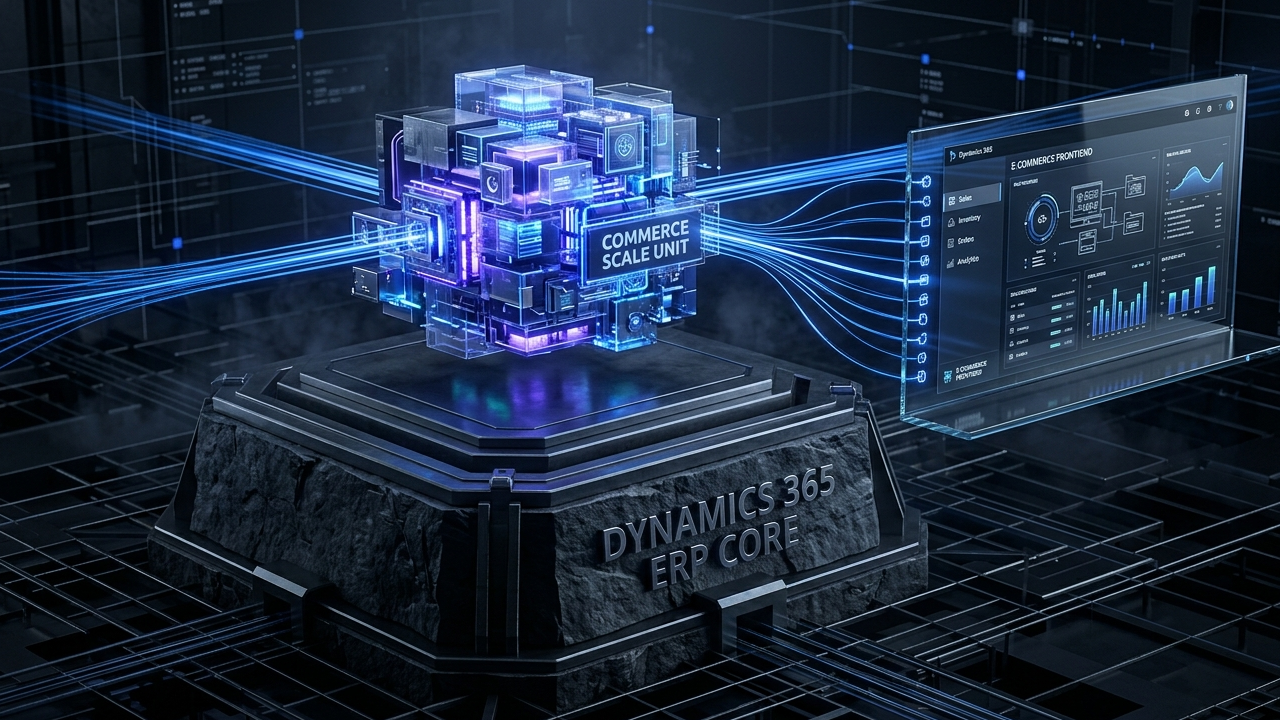
Establishing a high-fidelity microsoft dynamics ecommerce integration necessitates the orchestration of complex OData v4 streams and the implementation of event-driven patterns to ensure architectural scalability. This guide analyzes the transition from legacy batch processing to real-time service mesh synchronization.
Key Takeaways (TL;DR)
- Infrastructure Offloading: Utilizing the Commerce Scale Unit (CSU) decouples transactional logic from the ERP core, preventing performance degradation of back-office operations during peak traffic.
- Latency Mitigation: Transitioning from standard OData polling to Azure Service Bus event-driven triggers reduces API latency by up to 70% in high-concurrency B2B environments.
- Data Fidelity: Real-time state synchronization for contract-specific pricing and inventory quotas is mandatory to eliminate order-to-cash discrepancies in global deployments.
- Strategic TCO: A middleware-first integration strategy lowers the TCO by isolating ERP logic and reducing the requirement for expensive, proprietary X++ customizations.
For the enterprise CTO, a robust microsoft dynamics ecommerce integration is the cornerstone of a unified data fabric. Within a MACH architecture, Dynamics 365 acts as the definitive system of record, but its internal complexity requires a sophisticated abstraction layer to serve a modern headless storefront. Architects must move beyond simple point-to-point connections and adopt MACH architecture implementation patterns that leverage Microsoft’s Retail Server and CSU to expose business logic as high-performance, consumable APIs.
Architectural Patterns: Native Commerce vs. Custom API Mesh
The decision to utilize the native Dynamics 365 Commerce module versus a third-party commerce engine integrated via APIs dictates the long-term scalability of the stack. While the native suite offers tighter state synchronization, it often imposes constraints on frontend flexibility. Conversely, a custom integration allows for an enterprise e-commerce TCO analysis that favors best-of-breed services for search, CMS, and checkout, provided the API latency of the ERP round-trip is mitigated at the middleware level.
| Technical Attribute | Native D365 Commerce | Decoupled (Headless) API Integration |
|---|---|---|
| Data Sync Logic | Internal (Sync Service) | External Middleware / OData v4 |
| API Latency | Low (Native Engine) | Variable (Requires Edge Caching) |
| Frontend Extensibility | Restricted to SDK Templates | Unlimited (Next.js, Remix, etc.) |
| Persistence Management | Atomic within D365 | Distributed / Eventual Consistency |
Harnessing OData v4 for Real-Time State Synchronization
The technical core of a successful microsoft dynamics ecommerce integration is the efficient consumption of the OData v4 Service Layer. Unlike legacy SOAP interfaces, OData v4 supports JSON payloads and asynchronous batching, which is critical for syncing massive B2B price lists without triggering database locks. However, the throughput limits of the D365 Finance & Operations environment will throttle unoptimized requests. Senior developers must implement an integration layer that performs “delta-only” updates, ensuring that only modified records are transmitted to the headless storefront.
Technical Implementation: Synchronizing Complex B2B Quotes
In enterprise B2B scenarios, quotes often contain hundreds of line items with specific regional tax overrides. The following JSON payload represents a standardized integration object sent via a middleware layer to the D365 Sales Order header, ensuring data integrity during the state synchronization process.
{
  "dataAreaId": "USMF",
  "SalesOrderNumber": "ORD-99823-A",
  "OrderingCustomerAccountNumber": "CUST-001",
  "SalesOrderLines": [
    {
      "ItemNumber": "SKU-5542",
      "SalesQty": 500.0,
      "SalesPrice": 125.50,
      "FixedPriceFlag": "Yes",
      "WarehouseId": "WH-EAST-01",
      "LineDisc": 12.50
    }
  ],
  "IntegrationMetadata": {
    "SourceSystem": "HeadlessStorefront_V3",
    "SyncTimestamp": "2026-04-27T10:00:00Z",
    "OrchestrationNode": "AzureLambda_04"
  }
}
Scalability and Performance Bottlenecks
Scaling a microsoft dynamics ecommerce integration is frequently limited by the OData request execution time. Without a robust caching strategy (e.g., Redis or Memcached) at the middleware level, the storefront performance is directly tethered to the ERP’s query processing speed. This is non-viable for sub-second TTI (Time to Interactive) requirements. The architectural solution is to utilize the CSU’s “Commerce Data Exchange” (CDX) to push data to an asynchronous channel, allowing the frontend to consume data from a high-speed search index rather than querying the ERP database directly.
Furthermore, developers must account for the “Governor Limits” of the D365 environment. Continuous polling for inventory updates will exhaust API quotas and increase API latency for other critical processes. Implementing a webhook-based architecture via Azure Logic Apps or Functions ensures that synchronization is event-driven, preserving infrastructure resources and maintaining the performance of the headless storefront during peak B2B procurement cycles.
Architectural Outlook
Over the next 18-24 months, microsoft dynamics ecommerce integration will evolve toward “Semantic Data Fabrics.” Microsoft Fabric and the Common Data Model (CDM) will allow for near-zero-latency data sharing between the ERP and commerce layers without traditional ETL pipelines. We anticipate a shift toward “Predictive Orchestration,” where AI-driven middleware anticipates stock-outs and pricing fluctuations within D365 and pre-emptively updates the edge cache of headless storefronts before a user request is even initiated. Architects who transition to these streaming-first paradigms today will avoid the massive technical debt of traditional polling-based integrations.