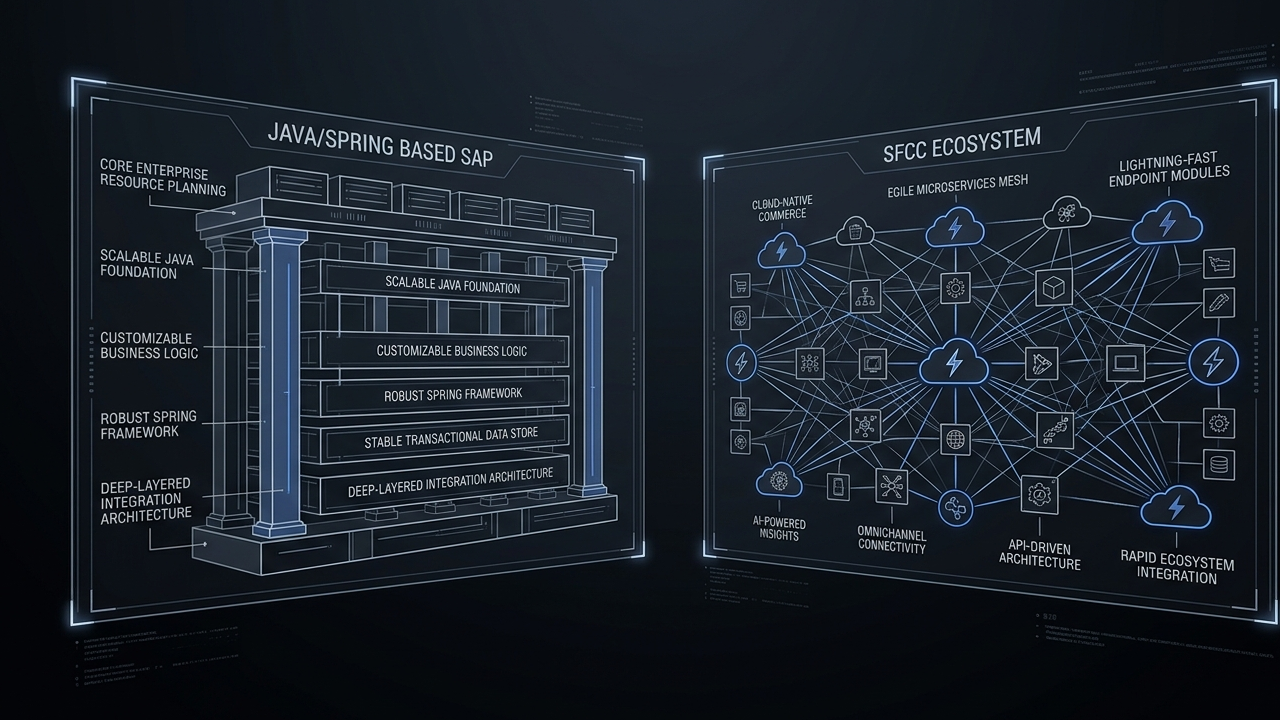
Evaluating the structural divergence between high-extensibility Spring-based frameworks and multi-tenant SaaS ecosystems for enterprise B2B infrastructure. This analysis focuses on data sovereignty, persistence layer control, and API orchestration.
Key Takeaways (TL;DR)
- Data Modeling Complexity: SAP Hybris Commerce Cloud utilizes a sophisticated Type System (XML-based) that excels in complex B2B product hierarchies; SFCC relies on a more rigid, metadata-driven approach.
- Infrastructure Model: SAP offers a PaaS/Private Cloud model allowing deep JVM-level tuning; SFCC is a pure multi-tenant SaaS, shifting the burden of scalability to Salesforce but limiting kernel access.
- Economic Impact: Hybris demands significant Dev-Ops and Java expertise, increasing the initial TCO, whereas SFCC utilizes a revenue-share model that impacts long-term margins as GMV scales.
- Headless Integration: Both platforms support decoupled architectures, but Hybris requires more manual API latency optimization compared to the native edge-caching of SFCC.
Deciding between sap hybris commerce cloud and Salesforce Commerce Cloud (SFCC) is a choice between architectural autonomy and operational abstraction. For enterprise B2B organizations, the decision hinges on the depth of the required customization within the core commerce engine. SAP Hybris (now SAP Commerce Cloud) provides a Java-based, Spring-framework environment that allows for radical modifications to the persistence and service layers. In contrast, SFCC (particularly the B2B on Lightning platform) offers a managed environment where scalability is guaranteed, but extensibility is confined to predefined hooks and API boundaries. This fundamental difference dictates the outcome of any enterprise e-commerce TCO analysis.
Data Modeling: Type Systems vs. Managed Metadata
The technical core of sap hybris commerce cloud is its flexible Type System. Engineers can define complex relationships, multi-level price rows, and localized attributes directly in the XML-based items.xml. This allows for native support of nested B2B organizational units and granular permissions without the need for external middleware. However, this flexibility requires a robust state synchronization strategy between the Hybris database and the search engine (Solr), as unoptimized queries on massive EAV (Entity-Attribute-Value) tables can degrade performance.
Salesforce Commerce Cloud approaches data through a more standardized B2B Object Model. While this accelerates deployment, it often requires architects to implement “workarounds” via custom objects when dealing with highly specialized industrial catalogs. For teams moving toward MACH architecture implementation patterns, the choice often favors the platform that can most cleanly expose its data layer through a high-performance GraphQL or REST API.
Architectural Taxonomy: Comparative Metrics
The following table outlines the technical deltas between the two ecosystems, focusing on infrastructure and development methodology.
| Technical Attribute | SAP Commerce Cloud (Hybris) | Salesforce Commerce Cloud (B2B) |
|---|---|---|
| Base Framework | Java / Spring / Type System | Salesforce Lightning / Apex |
| Deployment Model | PaaS (Managed Azure / Private) | Multi-tenant SaaS |
| Extensibility | Full Code (JVM Overrides) | Managed Hooks / Apex Triggers |
| API Architecture | Omni-Commerce Connect (OCC) | SCAPI (Salesforce Commerce API) |
API Orchestration and Headless Readiness
In a headless storefront configuration, API latency becomes the primary performance bottleneck. SAP hybris commerce cloud provides the OCC (Omni-Commerce Connect) REST API, which is highly customizable but can be “chatty.” To maintain sub-second response times, architects often implement a Backend-for-Frontend (BFF) layer to aggregate Hybris calls into a single JSON payload. This is essential for headless commerce performance optimization, especially when fetching complex B2B pricing with customer-specific discounts.
SFCC, through its SCAPI (Salesforce Commerce API), provides a modern, high-performance interface that leverages the Salesforce edge network. The scalability here is superior out-of-the-box, as the SaaS layer handles global traffic distribution. However, developers are limited by strict “governor limits”—API call quotas that, if exceeded during high-velocity integration periods, can lead to service throttling.
Technical Implementation: B2B Order Orchestration
Synchronizing a B2B order from a headless frontend to the SAP Hybris backend requires a structured OCC call. The following snippet illustrates a typical order submission that must be handled with care to ensure state synchronization with the underlying ERP (e.g., SAP S/4HANA):
// SAP Hybris OCC API: Headless B2B Order Submission
// Target: /v2/{baseSiteId}/users/{userId}/orders
async function submitB2BOrder(cartId, securityToken) {
    const payload = {
        cartId: cartId,
        termsChecked: true,
        // SAP-specific B2B fields for cost center and PO number
        costCenterId: "MARKETING_DEPT_01",
        purchaseOrderNumber: "PO-992834"
    };

    try {
        const response = await axios.post(HYBRIS_OCC_URL, payload, {
            headers: { 'Authorization': `Bearer ${securityToken}` }
        });

        // Critical: Hybris requires manual trigger for ERP sync in some PaaS setups
        return response.data;
    } catch (error) {
        console.error('B2B Order Sync Failure: API Latency or Validation Error');
        throw error;
    }
}
Extensibility and Maintenance Paradigms
The “Full Code” access of Hybris means that technical debt is a significant risk. If developers do not adhere to the SAP “Extension Concept,” the platform becomes impossible to upgrade. This requires a highly senior team of Java developers to maintain the stack. SFCC, being a managed SaaS, virtually eliminates the “upgrade” problem, but forces the engineering team into the “Salesforce way” of doing things. For organizations with unique, proprietary business logic that is a competitive differentiator, the PaaS flexibility of SAP Hybris remains the dominant architectural choice.
Architectural Outlook
Over the next 18-24 months, the evolution of sap hybris commerce cloud will be defined by its transition to “SAP Commerce Cloud, composable edition.” This involves decoupling the monolithic core into independent services (Spartacus for the frontend, and microservices for the backend). Salesforce will likely counter by further integrating B2B Commerce with its Data Cloud, using AI to automate the state synchronization of customer data across the CRM and Commerce layers. For the enterprise architect, the priority will shift from choosing a platform to managing the “Interaction Mesh” between these two giants and their respective API-first counterparts.